On a 200-table show in NYC, switching from vinyl rolls to Q-Tops saves about $3,650.
That isn’t a typo, and it isn’t a marketing number pulled out of the air. It’s what happens when you stop comparing the price tag on a roll of vinyl to the price tag on a fitted table topper, and start comparing what it actually costs to get a table covered before show day.
If you handle the procurement side of trade show supplies, you’ve probably looked at a spec sheet for vinyl roll table covers and a spec sheet for fitted Q-Tops side-by-side. The roll looks like a bargain. A standard vinyl roll runs around $165 and covers roughly 80–105 tables, depending on size — material cost lands somewhere between $1.09 and $2.46 per table. A fitted Q-Top runs $3.36 to $5.20 per table on material alone. On paper, it isn’t close.
That’s the entire reason vinyl rolls are still the industry default. And on material alone, that math is correct. The problem is that material is 5–10% of what it actually costs to cover a trade show table.
What the spec sheet doesn’t tell you
The spec sheet shows you material. It doesn’t show you setup — and setup is where the real cost lives.
Professional installation and dismantle (I&D) labor is a significant, skilled line item at every show. A 2025 analysis from Absolute Exhibits puts straight-time I&D rates between roughly $90 and $220 an hour depending on the city, with benefits adding another $24–$36 per hour. Metro Exhibits puts the working range at $125 to $475 per hour depending on city, specialization, and time of day. At Chicago’s McCormick Place specifically, Pure Exhibitor Survival Guide puts skilled labor at $125–$185 per hour straight time.
That’s the going rate for skilled trade show work, and it’s priced fairly for the expertise involved. Which means the math is simple: the faster and easier a task is to finish, the less it costs to complete — and the easier it is on the people doing it. That’s the variable that makes the whole comparison flip.
How long does it actually take to cover a table?
This is where the two methods part ways.
Vinyl rolls. A roll of vinyl is heavy — 50 pounds for a standard taffeta-embossed roll. It has to be carried to the table, measured, cut, positioned, stapled along the edges, and trimmed. The workflow needs two sets of hands — one to hold the vinyl taut, one to staple. In our observed field installs, a two-person team covers roughly 12 tables per hour at the 24″ size, slower at 30″. That’s about 0.17 worker-hours per table.
Q-Tops. Drape it over the table, push the corners down, and the patented PVC stretches to lock itself in place. No tools, no staples, no clips, no measuring. One person, no second set of hands needed, no hold-the-fabric-while-I-staple choreography. We use a conservative 20 tables per hour as our planning number — about 0.05 worker-hours per table, roughly a quarter of the time.
That’s the entire engineering case for the product in one paragraph: no cutting, no measuring, no stapling — just stretch and go.
Now you can do the real math.
The all-in cost per table, by venue
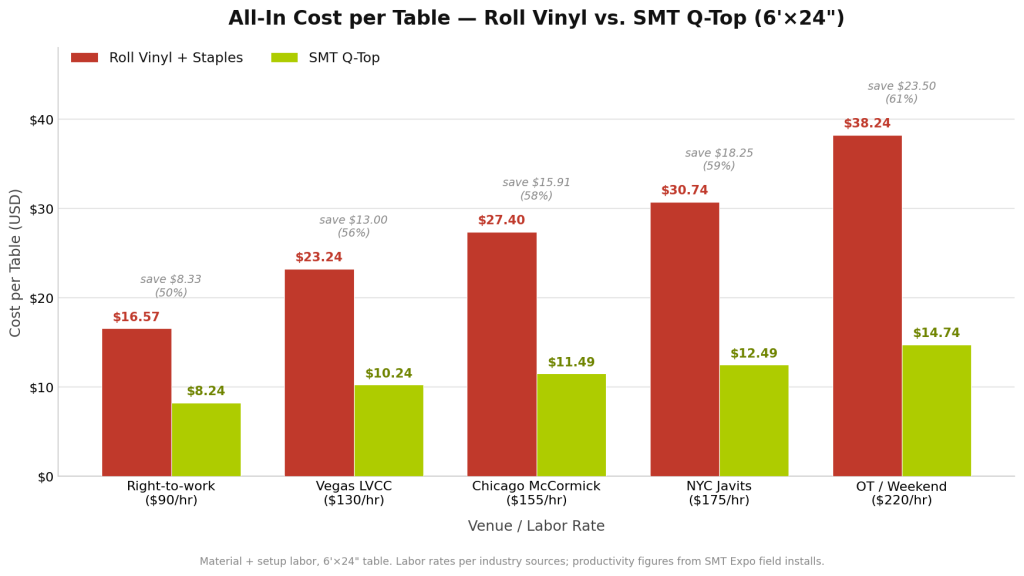
Here’s what material plus setup actually adds up to on a 6’×24″ table — the most common size on the trade show floor — at five realistic labor scenarios:
A few specific scenarios are worth calling out, because every show is somebody’s show:
A small show in a right-to-work city. Labor at $90/hr. Roll method comes in at $16.57 per table. Q-Tops come in at $8.24. On a 50-table booth, that’s $417 in savings. On a 100-table show, $833. Rolls still cost about twice as much as Q-Tops all-in.
A mid-size show at the Las Vegas Convention Center. I&D labor at $130/hr. Roll method jumps to $23.24 per table. Q-Tops, $10.24. On a 150-table footprint, you’re looking at roughly $1,950 in savings — material plus setup combined, every table, every show.
A major show at NYC Javits. Labor at $175/hr. Roll method hits $30.74 per table. Q-Tops, $12.49. That’s $18.25 saved on every single table. Run a 200-table show and you save $3,650. Run dismantle into overtime hours ($220/hr) and Q-Tops save $23.50 per table — a 62% reduction in all-in cost.
The pattern is the same at every venue: material cost slightly favors rolls, but the time and effort of setup favors Q-Tops by a wide margin — and time is the bigger number.
Better for the crew, not just the budget
The cost math is only half the story. The other half is who has to do the work.
Stapling fabric to tables — all day, across dozens or hundreds of tables — is the most physically punishing job on the setup list. It’s repetitive, it’s hard on the hands and wrists, and it’s done hunched over a table or down on the floor. Staple guns cause hand injuries. That kind of repetitive, awkward-posture work is exactly what shows up on worker-comp reports and slows a crew down by the end of a long install day.
Q-Tops take that job off the list. Drape, stretch, done — standing up, one motion, no tools. The crew gets through table setup faster and with far less physical toll, then moves on to the next task on the floor. Nobody’s hands get torn up. Nobody files a claim over a setup injury.
That’s what makes this a genuine win-win. The same change that saves the customer money also makes the work safer and less grueling for the people doing it. Faster, easier, and safer aren’t competing goals here — they’re the same goal. A good tool helps the customer’s budget and the crew’s body at the same time, and that’s exactly what a fitted topper does versus a staple gun and a roll of vinyl.
When does the roll method actually win?
Honestly: when there’s no setup labor to account for at all. If you’re a sole-proprietor exhibitor doing your own setup at a small regional show with one or two tables to cover, the roll’s low material cost is going to look attractive, and the time difference matters less when it’s just you and a couple of tables.
For everyone else — show decorators, general service contractors, event management companies, anyone who pays for professional setup — the roll method costs more in time, effort, and dollars on every table. The fitted-topper approach has quietly become the better deal for both the buyer and the crew.
What it means at scale
If you’re a general service contractor handling 2,500 tables a year (a normal mid-volume operation), the annual savings from switching off rolls land like this:
| Venue type | Annual savings (2,500 tables) |
|---|---|
| Right-to-work ($90/hr) | $20,800 |
| Vegas LVCC ($130/hr) | $32,500 |
| Chicago McCormick ($155/hr) | $39,800 |
| NYC Javits ($175/hr) | $45,600 |
| Overtime / weekend ($220/hr) | $58,700 |
That’s a line item your CFO will notice. It’s also a change that asks nothing of your crew except an easier day — no new equipment, no training, no process overhaul. Q-Tops drape onto the same tables you’re already using.
The bottom line
Vinyl rolls have been the default for thirty years because they look like the cheaper option on a procurement spreadsheet. They’re not. Once you account for the full cost of setup — not just material, but the time and effort it takes — fitted Q-Tops save 50–62% per table all-in, and they take the hardest, most injury-prone task off your crew’s plate while they’re at it.
Q-Tops are the only patented staple-free trade show table topper system on the market (U.S. Patent #7,178,470). They install in seconds with no tools, no clips, no staples, and no on-site cutting. Pair them with D-Skirts — our patented adhesive table skirting — and you have a complete table system that goes up faster, looks more professional, costs less to deploy, and is easier on everyone who touches it than the staple-and-roll method ever has been.
Get pricing for your next show. Ships to USA, Canada, and Mexico. No minimum order. Contact us at info@smtexpo.com or request a quote.
← Back to Blog